

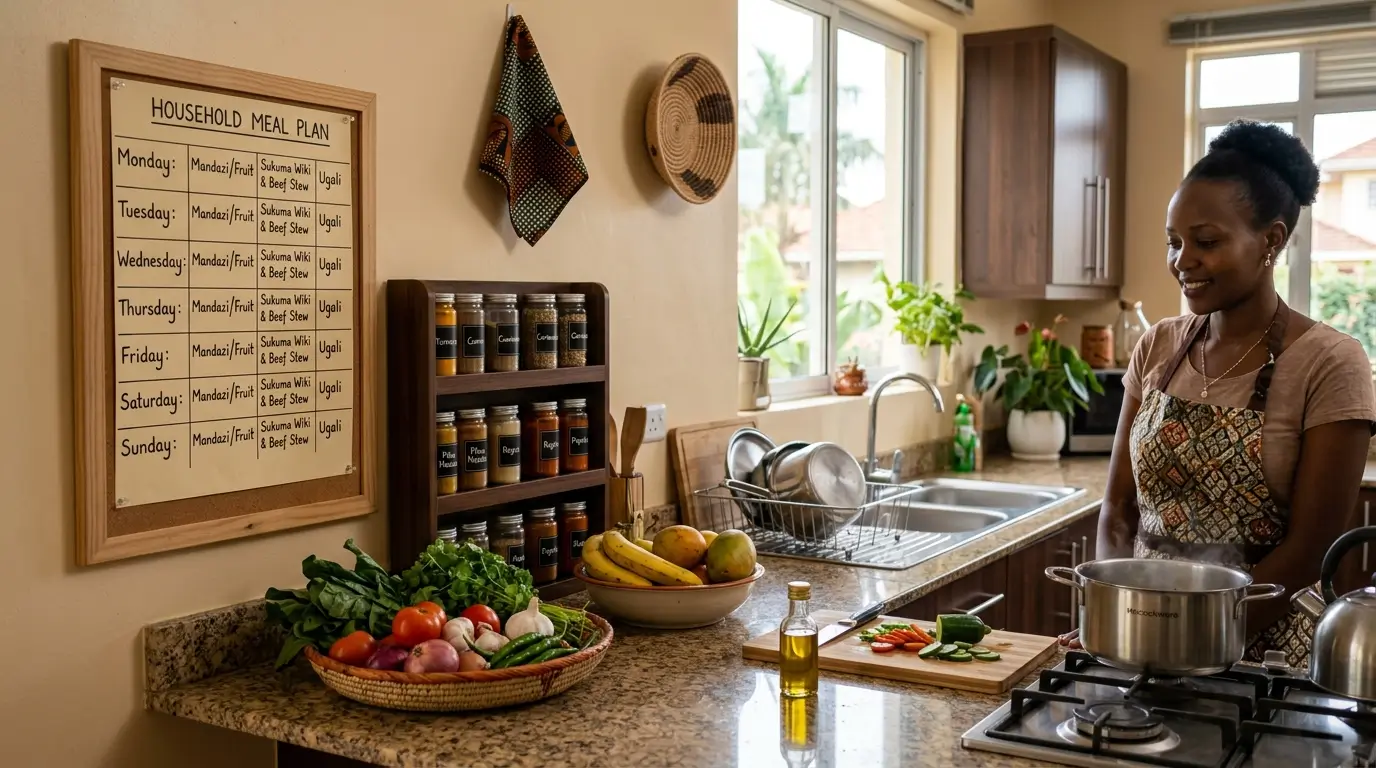
Learning how to write a menu plan for your house help to follow in Nairobi is one of the simplest yet most transformative things you can do to bring order, consistency, and peace to your household kitchen.
If you have ever come home after a long day at work, hungry and exhausted, only to find that your house help was not sure what to cook — or worse, made something the children refused to eat — you already know the problem that a good menu plan solves.
For many Nairobi families, the daily question of what shall we cook today? is an invisible but persistent source of stress. It eats into the house help’s productivity, leads to repetitive meals, wastes groceries, and can strain the relationship between an employer and their domestic worker.
A well-written menu plan for your house help to follow in Nairobi changes all of that. It removes the guesswork, empowers your house help to prepare meals confidently and independently, ensures your family eats a balanced and varied diet, and gives you one less thing to think about during an already demanding week.
In this step-by-step guide, we show you exactly how to write a menu plan for your house help to follow in Nairobi — with practical tips, a sample Kenyan weekly meal timetable, and everything your house help needs to cook your family’s meals with confidence.
Why Writing a Menu Plan for Your House Help to Follow in Nairobi Is a Game Changer
Before we get into the how, let us talk about the why — because understanding the full value of a menu plan will motivate you to actually sit down and write one this weekend.
It Eliminates the Daily “What Should I Cook?” Problem
Many Nairobi families experience a familiar pattern: the house help calls or texts the employer mid-morning to ask what to prepare for lunch. The employer, in the middle of a meeting or a deadline, has to stop and think. This happens every single day — for breakfast, lunch, and dinner — and it is exhausting for both parties.
A menu plan for your house help to follow in Nairobi solves this problem completely. The plan is already on the kitchen wall. The house help knows exactly what to prepare on Monday, what is on the schedule for Wednesday lunch, and what ingredients they need to pull from the pantry on Friday evening. No calls. No guessing. No disruptions.
It Ensures Your Family Eats a Balanced Diet Every Day
Without a plan, most households fall into a repetitive cycle of the same five or six meals — often driven by what the house help knows well or what is easiest to prepare quickly. Over time, this leads to nutritional gaps and a great deal of boredom at the dinner table.
A good Kenyan family meal plan helps to keep everyone healthy and nourished. Some organisation in the food and kitchen area can help you get through the clutter of the day. When you take the time to plan a varied, balanced menu in advance, you ensure your family gets the full range of nutrients they need — proteins, carbohydrates, vegetables, and fruits — across the week.
It Reduces Food Waste and Saves Money
One of the most underappreciated benefits of a menu plan for your house help to follow in Nairobi is how much it reduces grocery waste. With a detailed food plan, you can shop and stock the house with the ingredients needed to prepare each meal ahead of time, which in turn helps you save costs. It reduces the need to buy fast food or snacks and prevents the need to throw away unused foodstuff.
When your house help knows exactly what is being cooked this week, they can prepare a precise shopping list. Nothing gets forgotten, nothing gets wasted, and nothing gets bought twice.
It Empowers Your House Help to Work Independently and Confidently
A house help who does not know what to cook is a house help who cannot fully do their job. A clear menu plan gives your domestic worker the direction, confidence, and independence to manage your kitchen without constant supervision. This is particularly important for working parents in Nairobi who cannot be reached easily during the day.
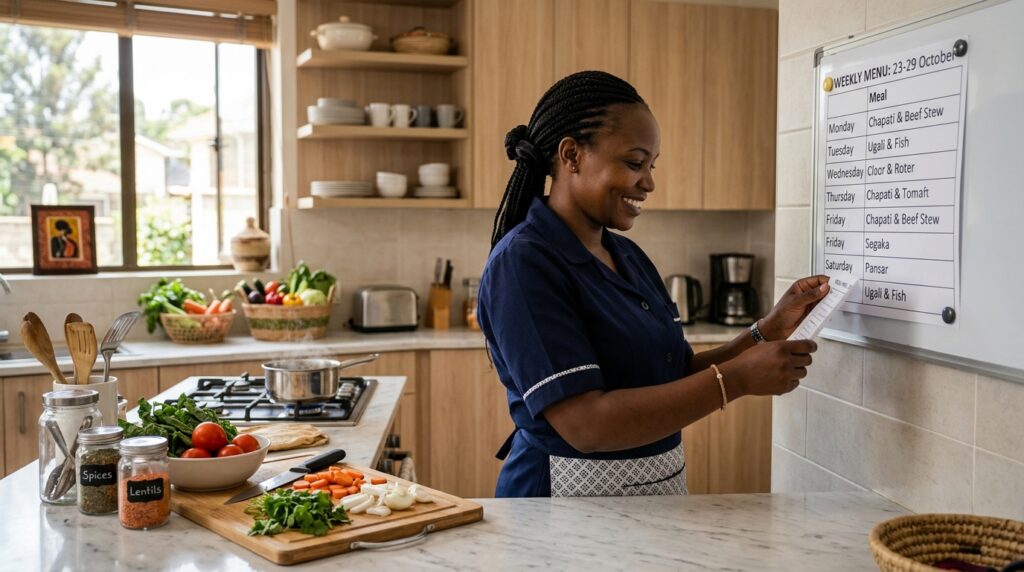
Step 1: Understand Your Family’s Needs Before Writing the Menu Plan for Your House Help to Follow in Nairobi
The most important step in writing a menu plan for your house help to follow in Nairobi is understanding your family before you plan a single meal. A menu plan that does not reflect your family’s actual preferences, dietary needs, and daily routine will not be followed for long.
Questions to Ask Yourself Before You Start
- How many people am I feeding? Include all household members — adults, children, and the house help herself if she eats with the family.
- Are there any food allergies or intolerances? Common ones in Kenyan households include dairy sensitivity, gluten intolerance, and nut allergies.
- Are there any medical dietary requirements? For example, a family member managing diabetes, high blood pressure, or high cholesterol may need specific foods avoided or reduced.
- What are the children’s preferences? Children can be picky eaters — building some of their favourites into the plan prevents mealtime battles.
- What is the household budget for food? Your meal plan should reflect what is realistically affordable week on week.
- How skilled is your house help in the kitchen? If she is an experienced cook, she can handle complex dishes. If she is newer to cooking, stick to simpler, clearly described meals.
- What are the weekly meal times? Does your family eat breakfast together? Do the children come home for lunch or stay at school? Is dinner always eaten as a family or staggered?
You can ask your kids and partner to help with this process. Doing this will give you a sense of direction on what to include in your meal plan and can even give you fresh ideas for whole new recipes.
Getting clear on these details before you write a single line of your menu plan for your house help to follow in Nairobi saves you time and ensures the plan is actually used.
Step 2: Choose Your Planning Format — Weekly or Monthly
When writing a menu plan for your house help to follow in Nairobi, you have two main format options: a weekly timetable or a monthly timetable. Both have merit, and the best choice depends on your household’s rhythm.
Weekly Menu Plan
A weekly menu plan covers seven days — Monday through Sunday — and lists the planned meals for breakfast, lunch, and dinner each day. This is the most popular format for Nairobi households because:
- It is easy to plan, write, and adjust
- It aligns with weekly grocery shopping habits
- It can be updated every week to introduce variety and adapt to what is in season
A weekly meal timetable is particularly important for working mums who do not have time to discuss what to cook every day with their house help.
Monthly Menu Plan
A monthly menu plan covers four weeks and is ideal for households that want longer-term structure and consistency. It requires more upfront planning but saves time every week because the thinking is already done. A four-week Kenyan meal timetable with alternatives every week ensures you have both variety and healthy Kenyan meals every single day of the month.
Recommendation for most Nairobi households: Start with a weekly menu plan. Once you are comfortable with the format and your house help is following it consistently, consider expanding to a monthly plan.
Step 3: Build a Balanced Menu Using Kenyan Foods Your Family Loves
Writing a menu plan for your house help to follow in Nairobi works best when it is built around familiar, locally available Kenyan foods that your family already enjoys — while intentionally introducing variety and nutritional balance.
The Building Blocks of a Balanced Kenyan Family Menu Plan
A balanced meal in a Kenyan household typically includes:
- A carbohydrate base — ugali, rice, chapati, bread, sweet potatoes, arrowroots, mukimo, matoke, or mandazi
- A protein source — chicken, beef, fish, eggs, lentils (ndengu), beans, or githeri
- Vegetables — sukuma wiki, spinach, cabbage, carrots, tomatoes, peas, or pumpkin
- A fruit or snack — mango, banana, watermelon, or avocado
For a nutritionally complete menu plan, aim to rotate proteins across the week — for example, chicken on Monday, fish on Wednesday, lentils on Thursday, and beef on Saturday. This keeps meals interesting and ensures your family gets a variety of essential nutrients.
Sample 7-Day Kenyan Menu Plan for Your House Help to Follow
Here is a sample week-long menu plan you can adapt and give to your house help in Nairobi:
MONDAY
- Breakfast: Uji (porridge) with mandazi / Milo with bread and egg
- Lunch: Ugali with sukuma wiki and beef stew
- Dinner: Rice with ndengu (green grams) stew and kachumbari
TUESDAY
- Breakfast: Boiled sweet potatoes or arrowroots with tea
- Lunch: Chapati with chicken stew and sliced tomatoes
- Dinner: Mukimo with fried cabbage and sausages
WEDNESDAY
- Breakfast: Bread with eggs (scrambled or boiled) and tea or juice
- Lunch: Rice with fish stew and steamed spinach
- Dinner: Githeri (maize and beans) with a side of sautéed kale
THURSDAY
- Breakfast: Uji with boiled eggs
- Lunch: Ugali with fried tilapia and sukuma wiki
- Dinner: Chapati with lentil (ndengu) soup and sliced avocado
FRIDAY
- Breakfast: Bread with groundnut butter and tea / Milo with mandazi
- Lunch: Pilau rice with kachumbari and a chicken piece
- Dinner: Ugali with beef and vegetable stew
SATURDAY
- Breakfast: Full breakfast — eggs, bread, sausages, sliced tomatoes, and tea or juice
- Lunch: Nyama choma or grilled chicken with ugali and kachumbari
- Dinner: Coconut rice with beans stew and sliced mango
SUNDAY
- Breakfast: Chapati with eggs and chai
- Lunch: White rice with chicken curry, cabbage salad, and a cold drink
- Dinner: Light meal — bread with avocado, boiled eggs, and tea

This is a starting template. Adjust it based on your family’s tastes, budget, and dietary needs. The goal is not a perfect plan — it is a practical, usable one that your house help can follow without confusion.
Step 4: Write the Menu Plan Clearly and Simply
The best menu plan for your house help to follow in Nairobi is one that is easy to read and impossible to misunderstand. How you present the plan matters just as much as what is in it.
Tips for Writing a Clear Menu Plan
Use a simple table or grid format. A table with days of the week across the top and meal times (breakfast, lunch, dinner) down the side is the clearest and most familiar format. Your house help can glance at it and instantly see what is needed.
Write in simple, clear language. Do not assume your house help knows all your cooking terminology or family preferences. Instead of “make the usual chicken thing,” write “prepare chicken stew with onions, tomatoes, pilipili, garlic, and royco — serve with rice.”
Specify portion sizes where relevant. If you have young children or specific dietary needs, note approximate portions — for example, “cook 2 cups of rice” or “make enough for 4 adults and 2 children.”
Include cooking notes for unfamiliar dishes. If you are introducing a new dish to the menu plan, write a brief note or attach a simple recipe card. Do not expect your house help to know how to prepare a meal they have never made before without instruction.
Print or write it out and display it visibly. The menu plan for your house help to follow in Nairobi should be physically accessible in the kitchen at all times — pinned to the fridge, stuck on a cabinet door, or placed in a plastic sleeve on the kitchen wall. A plan stored on your phone does not help your house help while you are at work.
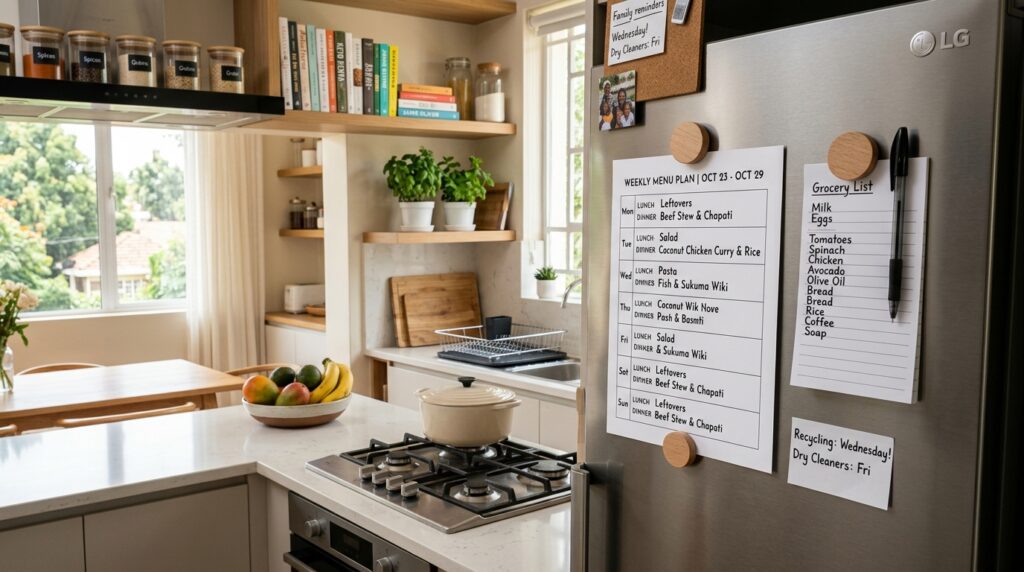
Step 5: Pair the Menu Plan with a Weekly Shopping List
A menu plan for your house help to follow in Nairobi is only as effective as the ingredients available to execute it. Pair your menu plan with a weekly shopping list that your house help can use to shop from the market or the supermarket.
How to Create a Shopping List from Your Menu Plan
Go through each meal on the weekly menu plan and list every ingredient needed. Then check your pantry and fridge for what is already available and remove those items from the list. What remains is your weekly shopping list.
Organise the shopping list by category to make shopping faster and more efficient:
- Produce — vegetables, fruits, and fresh herbs
- Proteins — meat, fish, chicken, eggs, and legumes
- Grains and starches — ugali flour, rice, bread, chapati flour
- Pantry staples — cooking oil, onions, garlic, tomatoes, salt, spices, royco, and other condiments
- Dairy — milk, yoghurt, or butter
- Beverages — tea, uji flour, juice, or Milo
Giving your house help a clear, categorised shopping list paired with the menu plan empowers her to handle grocery shopping efficiently and within budget.
Step 6: Communicate the Menu Plan to Your House Help Effectively
Writing the menu plan for your house help to follow in Nairobi is only half the work. The other half is making sure your house help understands it, is comfortable with it, and has everything she needs to execute it well.
How to Introduce the Menu Plan to Your House Help
Sit down together and go through it. The first time you introduce a menu plan, walk through it together. Explain each meal, answer any questions, and ask if there are any dishes she is not confident preparing.
Demonstrate unfamiliar recipes. If you are adding a new dish to the rotation, prepare it together the first time. Showing is always more effective than describing.
Encourage feedback. Your house help spends more time in your kitchen than you do. If she tells you that a particular dish always gets rejected by the children or that an ingredient is consistently unavailable at the market, listen and adjust the plan accordingly.
Review the plan together weekly. Take five minutes at the start of each week — perhaps on Sunday evening or Monday morning — to go through the upcoming week’s menu together. This keeps both of you aligned and gives your house help the chance to flag any concerns before the week begins.
Make it a routine, not a one-off. A menu plan becomes truly powerful when it is a consistent household habit — not something that happens once and then fades away. The more consistently you use it, the smoother your kitchen will run.
📸 [IMAGE: A Nairobi employer sitting at the kitchen table with their house help, going through a printed weekly menu plan together in a calm, collaborative atmosphere — representing effective communication and teamwork in the household]

Step 7: Review and Refresh the Menu Plan Regularly
A menu plan for your house help to follow in Nairobi should never be set in stone. As your family’s needs change — with the seasons, with the children’s growing tastes, with your budget, or with your health goals — your menu plan should evolve too.
How Often Should You Update Your Menu Plan?
- Weekly rotation: Keep the same structure but rotate meals to introduce variety and use what is in season.
- Monthly refresh: Every month, review which meals worked well, which were consistently skipped or disliked, and introduce two or three new dishes to replace them.
- Seasonal adjustments: Before making your meal plan, it helps to check for what is currently available as per the season. In Kenya, some vegetables and fruits are only affordable and fresh at certain times of year — your menu plan should reflect that.
- As the family changes: If a new baby arrives, if a family member develops a health condition, or if your household grows, revisit the menu plan entirely to ensure it still serves everyone well.
Common Mistakes to Avoid When Writing a Menu Plan for Your House Help to Follow in Nairobi
Even the best intentions can result in a menu plan that does not get used. Here are the most common mistakes Nairobi employers make — and how to avoid them:
Making It Too Complicated
If your menu plan includes dishes that require lengthy preparation, hard-to-find ingredients, or advanced cooking skills your house help does not have, it will be quietly abandoned. Start simple. Build complexity gradually as your house help grows more confident in the kitchen.
Not Considering the Children
A menu plan that does not account for the eating habits of young children leads to mealtime standoffs and wasted food. If your toddler refuses anything that is not ugali and stew, plan around that reality and introduce new foods slowly and intentionally.
Writing It Once and Never Looking at It Again
The most common reason menu plans fail is that they are treated as a one-time exercise rather than a living, evolving household tool. Schedule a regular weekly review and make updates a normal part of your household routine.
Forgetting to Account for Busy Days
Not every day of the week is equal. Monday evenings after a long day at work may not be the right time for a complex meal. Plan simpler, quicker dishes for your busiest days and save more elaborate meals for weekends when there is more time.
Not Including the House Help in the Planning Process
Your house help is your kitchen ally. Leaving her entirely out of the planning process — handing her a menu plan with no discussion — misses an opportunity for collaboration that makes the plan more effective and more enjoyable for everyone.
A Simple Template: How to Write a Menu Plan for Your House Help to Follow in Nairobi
Here is a simple, printable template format you can fill in each week and give to your house help:
HOUSEHOLD MENU PLAN — WEEK OF: ____________
| Day | Breakfast | Lunch | Dinner |
|---|---|---|---|
| Monday | |||
| Tuesday | |||
| Wednesday | |||
| Thursday | |||
| Friday | |||
| Saturday | |||
| Sunday |
Special notes / dietary requirements this week:
Shopping list for this week:
Meals the children prefer this week:
Print this template, fill it in each Sunday, and pin it to your kitchen wall. That is all it takes to bring structure, clarity, and calm to your household kitchen.
Frequently Asked Questions About Writing a Menu Plan for Your House Help to Follow in Nairobi
Start simple. Write a plain weekly timetable listing what you want cooked for breakfast, lunch, and dinner each day. Use familiar Kenyan meals your family already loves. Print it out or write it clearly and pin it in the kitchen. Review it together with your house help on Sunday evening and adjust as needed. You do not need a perfect plan — you need a practical one.
Write it in whichever language your house help is most comfortable reading. Many Nairobi domestic workers are comfortable with basic written English or Kiswahili. If your house help reads better in Kiswahili, write in Kiswahili. The goal is a plan she can read, understand, and follow independently — language should never be a barrier to that.
For most Nairobi households, a weekly menu plan is the most practical starting point — it aligns with weekly grocery shopping and is easy to adjust. Once you are comfortable with weekly planning, you can advance to a monthly rotation that you refresh and update each week.
Address this during your introductory conversation. If there are dishes on the plan she is not confident making, demonstrate the recipe together or provide a simple written recipe card. Consider her skill level when writing the plan and introduce more complex dishes gradually as her confidence grows.
Note all dietary requirements clearly at the top of the menu plan — for example, “no dairy for baby Amara” or “low salt for grandfather.” Colour-code or flag specific meals that have special preparation requirements so your house help can identify them at a glance. Discuss any critical dietary restrictions with your house help directly to ensure she understands their importance.
First, have a calm conversation to understand why. Is she unable to find a particular ingredient? Is a dish too time-consuming with the other tasks on her schedule? Is she unsure how to prepare something? Most deviations stem from practical barriers, not disregard. Adjust the plan to address those barriers and check in regularly to ensure it remains workable.
Yes — and it is considerate to do so. Many Nairobi households provide meals for their house help as part of the employment arrangement. If your house help eats with the family or prepares her own meals separately, note this in the plan so quantities are planned accordingly and there is no ambiguity around what she is entitled to prepare for herself.
Rotate dishes each week to prevent repetition. Introduce one or two new dishes per month to keep things fresh. Follow Kenyan food blogs, nutritionists, or social media pages for inspiration — there is a growing community of Kenyan home cooks sharing creative, affordable recipes specifically designed for local families. Seasonal variety also naturally introduces new ingredients and dishes throughout the year.
Final Thoughts: Writing a Menu Plan for Your House Help to Follow in Nairobi Is One of the Smartest Household Habits You Can Build
The effort it takes to write a menu plan for your house help to follow in Nairobi is measured in minutes. The returns — in time saved, money saved, stress reduced, nutrition improved, and a household that runs more smoothly — are felt every single day of the week.
It is a small habit with an outsized impact. And like all good household habits, it gets easier and more effective with every week you do it.
So this Sunday evening, set aside twenty minutes. Think about your family’s week ahead. Write down what you want on the table each day. Print it out, pin it up, and walk through it with your house help. That one small act of planning is the difference between a kitchen that runs with clarity — and one that runs on daily confusion and guesswork.
Your home deserves better than guesswork. And now you know exactly how to write a menu plan for your house help to follow in Nairobi that makes it happen.
Do you already use a menu plan with your house help in Nairobi? Share what works for your family in the comments — your tip could save another Nairobi household a week of kitchen stress!
💚 Need a skilled, reliable househelp or nanny in Nairobi?
Chillexy Househelps connects Nairobi families with thoroughly vetted, professionally trained, and compassionate domestic workers — matched to your exact household needs. Whether you need a reliable househelp who can follow your menu plan, a nurturing nanny, or a caring caregiver, Chillexy makes the process simple, safe, and stress-free.
✅ Fully vetted and background-checked candidates ✅ Matched to your specific household needs ✅ Ongoing support from consultation to onboarding